Sophie Llewellyn Smith is a conference interpreter with 15 years' experience of interpreter training. On her site theinterpretingcoach.com, you will find eBooks and eCourses to help you consolidate or update your interpreting skills in areas such as note-taking, research skills, analytical skills, and retour interpreting (working into a B language). Each course breaks the skills down into manageable sections and uses a mixture of text, audio and video to examine underlying principles and work on practical exercises. In this way, you can use self-study at your own pace to target your weaknesses, improve your performance and become more marketable.
In today’s exercise, you are going to practise making sentences using either efficient or effective.
Efficient or effective?
NOUNS
VERBS
communications
want
distribution network
deliver
engine
make
use of
implement
resources
use
attack
take
solutions
be responsible for
argument
be
action
help
policy
develop
strategy
prove
speech
discovery
process
become
administration
appear
technique
transport system
drugs
marketing tools
postal service
Above is your smorgasbord of options for creating sentences. Your task is to pick one noun and one verb, and craft five sentences (or ten, if you’re feeling keen). Each sentence must contain either the word effective, or the word efficient, depending which one is appropriate in context.
For example, your sentence might be:
The UK does not have a very efficient transport system.
Of course you can make your sentences far longer and more elaborate than that!
Most of my readers and clients are conference interpreters. The types of meetings we interpret at usually call for a neutral-ish register, sometimes with elements of formality or technical vocabulary.
In general, I have found that my coaching clients sometimes struggle with everyday, colloquial language, but they don’t often have to produce that sort of register at work; whereas a formal register is important when interpreting politicians’ speeches, inaugural addresses, prize-giving ceremonies, etc.
This is why I’ve chosen to focus on improving your formal register.
Hallmarks of formal register in speech
There are certain elements of syntax and vocabulary that mark speech (and writing) as being either towards the formal end of the spectrum, or closer to the informal end.
Exercise 1: brainstorming
I’m sure you can think of some of these features. Take a minute to write down everything you can think of that indicates formality in English (it may not be the same as in your A language; for example, the ‘tu/vous’ or ‘du/Sie’ distinction may be a very obvious way to show formality in your A language, but it doesn’t exist in English).
Exercise 2: comparing texts
Find two articles about the same subject, one from a tabloid (The Sun, The Mirror, The Star), and one from a broadsheet such as The Guardian or the Financial Times.
Use a highlighter to go through the two articles, picking out expressions you consider to be particularly formal or informal. Think about how the two publications talk about the same thing, and what linguistic devices they use. See if you can add to your list or table of formal/informal features (that you started in exercise 1).
I’ve suggested two articles (below), but you can of course find your own!
Keir Starmer vows to FREEZE council tax bills – days before Brits hit with massive hike
Keir Starmer will tomorrow unveil a major promise to freeze council tax bills.
Launching Labour’s local election campaign in Swindon, it is the “party of lower taxes for working people”.
As households face a hike in bills on Saturday, he will say he would use a windfall tax on oil and gas giants to stop them rising this year if he was in power.
Average council tax bills are set to exceed £2,000 for the first time as families are clobbered with a 5.1% increase.
The average Band D council tax set by local authorities in England for 2023-24 will be £2,065 – a rise of £99 on the 2022-23 figure of £1,966.
Chancellor Jeremy Hunt has allowed cash-strapped councils to bring in the whopping increases as they struggle with government cuts.
Previously, town, city and county halls could only increase bills by 3% without a referendum.
At Labour’s local election launch on Thursday, Mr Starmer will say: “If there was a Labour Government, you could take that council tax rise you just got and rip it up.”
Taking aim at Rishi Sunak’s plan to hand a tax cut to those with the biggest pension pots, he will say: “A Labour Government would freeze your council tax this year – that’s our choice.
Labour would freeze council tax for one year, says Keir Starmer
Keir Starmer has pledged to use an extended windfall tax to freeze council tax for one year as Labour kicked off its local election campaign on Thursday.
Days before millions of people in England see their council tax bills rise by 5% in April, the Labour leader challenged Rishi Sunak to use “the money that is already on the table” and introduce the tax cut tomorrow.
However, Starmer would not commit to freezing council tax if Labour won the next general election.
In the local elections on 4 May more than 8,000 council seats will be contested across 84 metropolitan, unitary and district councils in England, as well as four English mayoralties.
Calling the prime minister “Mr 1%”, Starmer said at an event in Swindon that the Conservatives would always promise “tax cuts for the richest 1% while working people pay the problem, but this has to change”.
Starmer insisted the government had the money to freeze council tax bills but was choosing not to. Speaking alongside Angela Rayner and Rachel Reeves, he said Labour’s council tax cut “matches the ambition” of communities that wanted change but were being failed by the Conservative government.
The Guardian understands that Labour would fund the council tax cut using its proposed extended windfall tax that the Conservatives did not adopt in full.
Reeves, the shadow chancellor, said the council tax cut pledge showed a clear difference between who the prime minister stood for and who Labour represented.
Labour sees the 4 May poll as an opportunity to road-test some its policy ideas on NHS waiting lists and safer streets, as well as the cost of living crisis, rather than just going on the attack.
What does your list or table look like? Here’s what I picked up on in the two articles above:
Text 1: more INFORMAL. Words in capitals; emotive language; vocabulary like ‘cash-strapped’, ‘a hike’, ‘clobbered with’.
Text 2: more FORMAL. Longer sentences; more indirect sentence structure; vocabulary like ‘to be contested’, ‘to adopt in full’.
And here is my table:
Table of hallmarks of register
LOWER REGISTER
MORE FORMAL REGISTER
Vulgarity, swear words
Fillers (I mean, you know, like, so)
Contractions
Full forms
Idioms?
Phrasal verbs
Latin or Greek roots
Active verb form
Passive verb forms
Abbreviations
Full form
Short Anglo-Saxon words (do, hit, put, look, give, run, jump, buy)
Latin or Greek origins
Common words
specialised or technical words
Direct questions
Indirect questions
Simple sentences
Long sentences, complex grammar (subordination)
Question tags
Lots of; loads of; make, do, get, nice, good
“A great deal of”, “many”; more precise vocabulary
more personal
More impersonal
Sloppy pronunciation, glottal stops
Clear enunciation
The exercises I’ve focused on so far aim to improve your awareness of register.
To make improvements in your formal register, you will need to do three things (concurrently, if you like):
improve your awareness
do some vocabulary-building
activate your new expressions
I can’t cover them all in a single post, so I’ll suggest two more exercises to work on awareness:
pure shadowing (i.e. simultaneously repeating what a speaker is saying). Pick a speech in English that you know to be formal because of the setting (an academic conference, a speech by a Head of State, etc.) and shadow it. Get used to saying some of the more formal phrases out loud. Write down any useful phrases.
highlighting useful phrases: choose a text that you know is formal, for example an article in an academic journal, an opinion piece in a reputable publication, or the transcript of a politician’s speech. You may need some help from a native speaker, because some journalistic writing in English isn’t actually that formal. Go through the text with a highlighter, picking out formal collocations or phrases. Have a think about what you might have used instead – would you have chosen a more informal option? Note down 3 or 4 formal phrases and make up some example sentences to say out loud.
I hope this post has given you some ideas! More on register soon…
I’ve written quite a lot about speech preparation as a useful exercise, both for interpreters and for trainers.
In this post, for example, I’ve talked about the benefits of speech prep, and in this one, I’ve outlined how I go about preparing a speech quickly and efficiently.
Today, I want to talk about how you can create an outline for three different types of speech very quickly – i.e., how to extract the maximum amount of juice from your hard work! If you’re a trainer, for instance, you don’t want to spend 2 hours on a single speech. The process I will describe will allow you prepare three speeches in one fell swoop – or even more!
The idea is to use the same research and background knowledge to create a simultaneous, a consecutive with notes, and a consecutive without notes on the same subject. But read on, and you’ll see that you can take things even further and prepare several short speeches on different subjects, or approach a subject from different angles.
Step 1: create an outline for a consecutive speech
For more detail on how to pick a suitable subject and research it, refer to my previous post.
In brief, I chose bedbugs as my topic, because I heard a piece about the recent outbreak on a Radio 4 programme called ‘PM’, and the very next day, an interpreting colleague mentioned she had been evacuated from a Paris-Strasbourg train because of bedbugs.
I often start with an outline for a consecutive with notes, because that’s the type of speech I prepare more frequently, but you could also start with a consecutive without notes, as I’ve done here.
Consecutive without notes is by definition a short exercise without too many demands on the interpreter’s memory, i.e. few figures, dates, or names, so it’s easy to come up with an outline. You can generally only cover two or three points, subsumed under one or two main ideas, in a consecutive without notes.
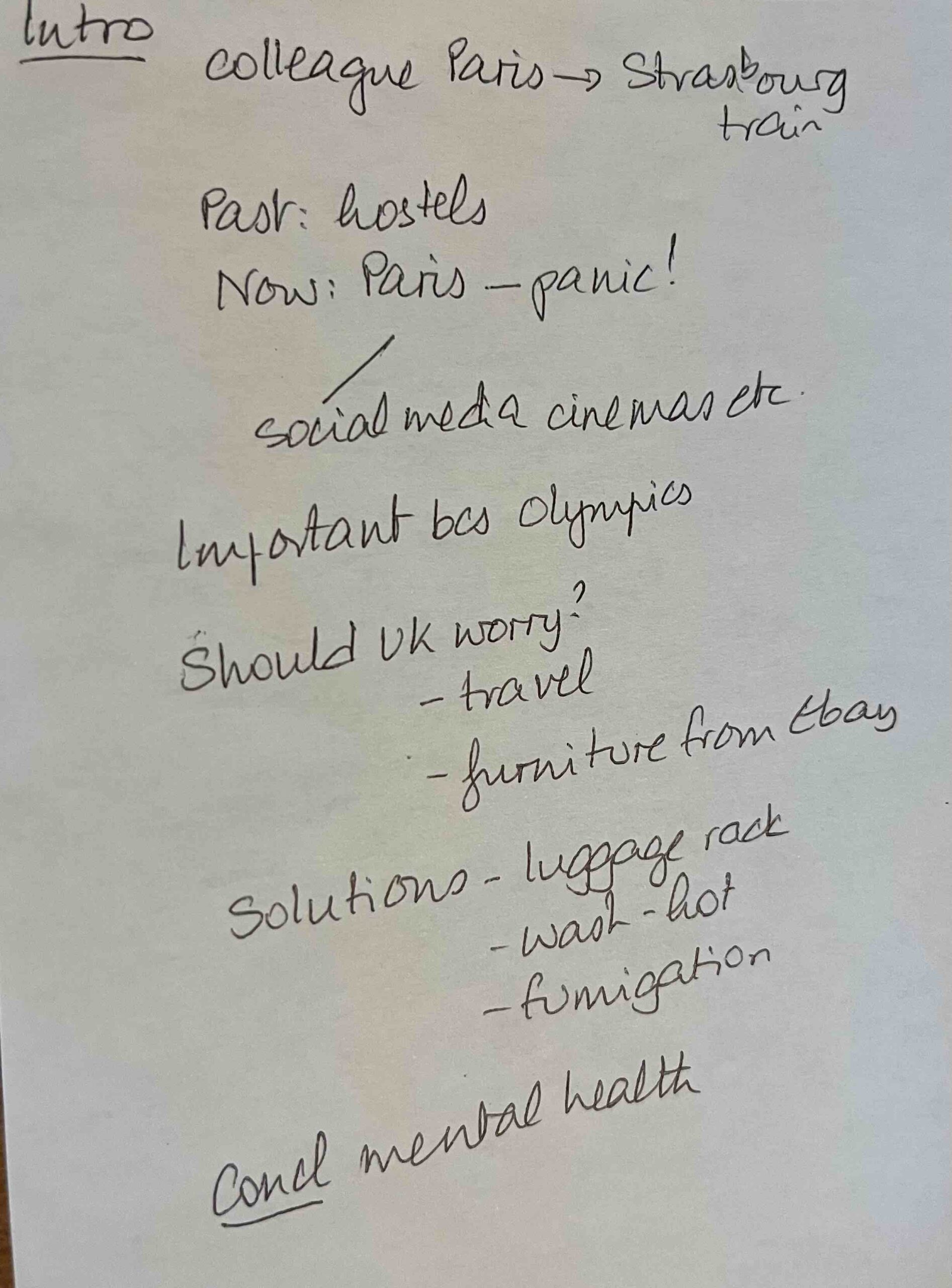
Here, I’ve giv aden a personal/visual introduction, briefly explained what’s happening in France and why it’s important, then turned to whether the UK should worry, and how you can get rid of bedbugs.
With 10 minutes of research and a few minutes listening to the radio in the car, we now have an outline for a consec without notes.
How to take it further so that we can create several more speeches based on the same material?
Expanding a short speech into a longer one
On this occasion, since I had started with a consec without notes, I looked for ways to expand it into a consecutive with notes.
There are many options for introducing more challenges into a speech. You could add:
figures
more detail or secondary information
someone else’s point of view
a personal opinion
interesting language (e.g. images, idioms)
a quotation
a digression
a whole other idea or argument
On this occasion, I decided to expand the speech as follows:
give two figures (one from Rentokil, the pest control agency, and the other referring to the number of households in France that had a bedbug infestation)
use some more interesting descriptive language about bedbugs, and to describe Paris and London
talk more about what political action is being taken in France; this was an opportunity to include several points of view
give a bit of history about bedbugs, to introduce a date, and a technical term (DDT, the name of a pesticide)
add a little more detail here and there
Expanding a consecutive into a simultaneous
When I prepare consecutive speeches, they typically last 2-5 minutes (consec without notes), 5-7 minutes (consec with notes), or 10-12 minutes (simultaneous). That’s because I work for the EU institutions and train interpreters who want to work for the EU, and the EU accreditation test uses speeches of that length.
Filling 10-12 minutes of time on a specific subject is quite different from preparing a 3 minute consec without notes. You need more facts and figures, so you can expand more on your ideas. Or you need to structure your speech so that it contains more arguments/ideas (e.g. someone else’s point of view, for instance).
Generally speaking, this requires a bit more research. On this occasion, I had everything I needed from the two articles and radio programme. All I had to do was organise the material in a way that suited me; I added whole extra sections (“has there really been an increase in the number of bedbugs?” and “what risk do they pose?”), as well as changing the conclusion.
I’ve put my three speech outlines in a table, so you can compare them and see how I’ve added information to turn the original short speech into a longer consec with notes and then a simultaneous.
In the first column (my original outline for a consec without notes), I’ve put the links between ideas in bold.
In the second and third columns, I’ve put extra information in bold.
CONSEC WITHOUT NOTES
CONSEC WITH NOTES
SIMULTANEOUS
Intro: colleague travelling by train from Paris to Strasbourg is evacuated bcs of bedbugs
Intro: colleague travelling by train from Paris to Strasbourg is evacuated bcs of bedbugs
Intro: colleague travelling by train from Paris to Strasbourg is evacuated bcs of bedbugs
We used to encounter bedbugs in dodgy hostels when backpacking around the world; now they’re everywhere in Paris
We used to encounter bedbugs in budget hostels when backpacking around the world during gap year – red bites on arms and legs; now they’re everywhere in Paris/France
We used to encounter bedbugs in budget hostels when backpacking around the world during gap year – red bites on arms and legs; now they’re everywhere in Paris/France
Or at least they’re everywhere on social media! Examples: Fabric seats on trainsCinemasCharles de Gaulle airport-> widespread panic, people standing
Or at least they’re everywhere on French social media! Photos, videos of nasty little critters: – Metro – people standing – Cinemas – Charles de Gaulle airport-> widespread panic & paranoia
Or at least they’re everywhere on French social media! Photos, videos of nasty little critters: Metro – people standingCinemasCharles de Gaulle airportFigs: Anses (French national health body) says 11% households infested over past 5 years. -> widespread panic & paranoia
Why is this important? Bcs France is hosting the Olympic Games next year, so must be seen to be doing something
Why is this important?Bcs France is hosting the Olympic Games next year, so must be seen to be doing something (image)
Why is this important? Bcs France is hosting the Olympic Games next year, so must be seen to be doing something (image)
Political action: – Paris City Hall says invasion must be tackled, has written to PM & is calling for a dedicated national taskforce – Transport Minister has summoned train and bus operators to talk about how to prevent bedbugs multiplying on seats
Political action: – Paris City Hall says invasion must be tackled, has written to PM & is calling for a dedicated national task force – Transport Minister has summoned train and bus operators to talk about how to prevent bedbugs multiplying on seats
History: we thought bedbugs disappeared in 1950s bcs of chemical treatments e.g. DDT, but recent resurgence.
History: we thought bedbugs (mattresses, clothes, luggage; come out at night to feed on human blood) disappeared in 1950s bcs of chemical treatments e.g. DDT, but recent resurgence.
Should UK worry that bedbugs will cross the Channel (Eurostar)? Bedbugs can survive on seats & British people on hols can bring back bedbugs in suitcaseOther source: second hand furniture on resale sites e.g. Ebay and Fbook marketplace
Should people worry that bedbugs will cross the Channel from the City of Love to the Big Smoke? Yes: – Bedbug lifespan is 4-6 months, can survive for a year without eating, so could get into Eurostar seats or dirty suitcase – Other source of bedbugs in UK: second hand furniture on resale sites e.g. Ebay and Fbook marketplace
Should people worry that bedbugs will cross the Channel from the City of Love to the Big Smoke? Yes: – Bedbug lifespan is 4-6 months, can survive for a year without eating, so could get into Eurostar seats or dirty suitcase – Other source of bedbugs in UK: second hand furniture on resale sites e.g. Ebay and Fbook marketplace
How to protect yourself? If travelling, use luggage rack rather than putting case on bed and unpackingOnce home, put clothes through hot wash and dry at high tempSecond hand furniture: use steam cleanerIf necessary, use e.g. Rentokil to kill all bedbugs
How to protect yourself? If travelling, use luggage rack rather than putting case on bed and unpackingOnce home, put clothes through hot wash and dry at high tempSecond hand furniture: use steam cleaner If necessary, use e.g. Rentokil to kill all bedbugs
How to protect yourself? If travelling, use luggage rack rather than putting case on bed and unpackingOnce home, put clothes through hot wash and dry at high tempSecond hand furniture: use steam cleaner If necessary, use e.g. Rentokil to kill all bedbugs
Rentokil says there has been a 65% increase, year-on-year, in infestations
Rentokil saysthere has been a 65% increase, year-on-year, in infestations But this is not a good solution for low income households bcs high cost
But most experts are saying it’s not the number of bedbugs that’s increasing, but number of sightings (social media).
Are there reallymore bedbugs in France or more sightings? Social media can make it appear that there’s a massive problem
Are there reallymore bedbugs in France or more sightings? Social media can make it appear that there’s a massive problem
Figs: Anses (French national health body) says 11% households infested over past 5 years. Is that really an increase? I’m not sure.
Is that really an increase? Experts say there’s always an increase in after July/Aug holidays. People bring them home in their luggage. But it does seem as if there is a resurgence, for several reasons: – Globalisation: container trade, tourism, immigration – Ban on DDT, so not eliminated by chemicals – Survivors are more resistant – Reduction in number of cockroaches (revolting, I think), which are bedbug predators – [BTW] for once, it’s not climate change – bedbugs are domesticated and follow humans, but global warming hasn’t changed habitat
Unfortunately, that can generate panic and cause mental health problems (paranoia about bugs in mattress -> insomnia, anxiety, depression)
What IS increasing: mental health problems, e.g. insomnia, anxiety, depression.
What risk do they pose? – They don’t carry transmissible diseases – The bites don’t last. – They’re embarrassing (yuck factor) and inconvenient (cinema, travel) – I think BIGGEST RISK: mental health problems, e.g. insomnia, anxiety, depression
CONCLUSION: like headlice, they’re an inconvenience rather than health risk – easily dealt with though chemical resistance is more of a challenge. Experts tell us that we should target superspreaders, often ill, poor, marginalised. Whole other can of worms.
Here’s another table about the same three speeches. Instead of writing out the whole content of the speech, I’ve highlighted the additions and stated (in bold) what kind of additional challenge this represents for the interpreter.
CONSEC WITHOUT NOTES
CONSEC WITH NOTES – additions & type of challenge
SIMULTANEOUS
Intro: colleague travelling by train from Paris to Strasbourg is evacuated bcs of bedbugs
We used to encounter bedbugs in dodgy hostels when backpacking around the world; now they’re everywhere in Paris
red bites on arms and legs > secondary information
Or at least they’re everywhere on social media! Examples: Fabric seats on trainsCinemasCharles de Gaulle airport-> widespread panic, people standing
Photos, videos > secondary information of nasty little critters > use of language
Why is this important?Bcs France is hosting the Olympic Games next year, so must be seen to be doing something
Political action: – Paris City Hall says invasion must be tackled, has written to PM & is calling for a dedicated national taskforce – Transport Minister has summoned train and bus operators to talk about how to prevent bedbugs multiplying on seats Different viewpoints
History: we thought bedbugs disappeared in 1950s bcs of chemical treatments > date e.g. DDT, but recent resurgence. > technical detail (subject knowledge)
(mattresses, clothes, luggage; come out at night to feed on human blood) > secondary information/lists
Should UK worry that bedbugs will cross the Channel (Eurostar)? Bedbugs can survive on seats & British people on hols can bring back bedbugs in suitcaseOther source: second hand furniture on resale sites e.g. Ebay and Fbook marketplace
the City of Love, the Big Smoke > use of language, imagery Bedbug lifespan is 4-6 months, can survive for a year without eating > numbers
How to protect yourself? If travelling, use luggage rack rather than putting case on bed and unpackingOnce home, put clothes through hot wash and dry at high tempSecond hand furniture: use steam cleanerIf necessary, use e.g. Rentokil to kill all bedbugs
Rentokil says there has been a 65% increase, year-on-year, in infestations >figure
But this is not a good solution for low income households bcs high cost > Extra argument
But most experts are saying it’s not the number of bedbugs that’s increasing, but number of sightings (social media).
Figs: Anses (French national health body) says 11% households infested over past 5 years. > figure Is that really an increase? I’m not sure. > personal opinion
Is that really an increase? Experts say there’s always an increase in after July/Aug holidays. People bring them home in their luggage. But it does seem as if there is a resurgence, for several reasons: Globalisation: container trade, tourism, immigration Ban on DDT, so not eliminated by chemicals Survivors are more resistant Reduction in number of cockroaches (revolting, I think), which are bedbug predators [BTW] for once, it’s not climate change – bedbugs are domesticated and follow humans, but global warming hasn’t changed habitat > extra arguments/list
Unfortunately, that can generate panic and cause mental health problems (paranoia about bugs in mattress -> insomnia, anxiety, depression)
What risk do they pose? >whole extra section/argument They don’t carry transmissible diseases The bites don’t last They’re embarrassing (yuck factor) and inconvenient (cinema, travel)extra argument I think BIGGEST RISK:mental health problems, e.g. insomnia, anxiety, depression > personal opinion
CONCLUSION: like headlice, they’re an inconvenience rather than health risk – easily dealt with though chemical resistance is more of a challenge.
Experts tell us that we should target superspreaders, often ill, poor, marginalised. > New argument
Whole other can of worms. > Idiom/pun
I hope I’ve illustrated clearly how easy it can be to take two or three sources of information (podcasts, newspaper articles), and turn them into three different speeches in a relatively short space of time.
You can tailor the speech to your students’ or practice partners’ needs, by choosing different challenges to add (e.g. figures, lists, points of view, etc.)
Taking it even further
You could, of course, go even further than this.
The simultaneous outline I’ve created gives me scope for preparing several more speeches in similar, or even quite different, topics.
The easiest type of speech to produce would be consec without notes, since it hardly requires any more research. You can draw on background knowledge to expand the ideas or take them in new directions.
Here are some ways I could repurpose the underlying material in my simultaneous speech to produce several more consec without notes speeches:
A speech about what countries do in the run-up to the Olympics
Intro: bedbug problem in France is making headlines. Why? Olympics
> City Hall and Macron’s government are suggesting action (bcs of their image)
Other countries have done similar things in the run-up to Olympics, e.g. Athens rounding up stray dogs and getting homeless people off the streets
This is like only tidying your house when people are coming round for dinner! Better to do little and often,
Concl: countries should have appropriate policies that are not just predicated on public image
A speech about whether there has really been a resurgence of bedbugs
Intro: current bedbug problem in France. Is this really an increase in numbers?
No: there is always an increase after the summer holidays. This is just a normal cycle, but we’re talking more about it bcs of social media
Yes: globalisation; ban on DDT; resistant bugs; fewer cockroaches > there are, in fact, more bedbugs
Concl: take precautions
A speech about how social media can create panic
Intro: bedbug problem in France
use of social media causes panic > mental health problems
similar examples: COVID vaccine
Concl: social media can be beneficial (e.g. sharing useful info) but also exacerbate the problem
One of these speeches is about bedbugs, but the other two use the bedbug example to illustrate a different point. It only took a few moments of brainstorming to create an outline for the speeches.
Conclusion
I imagine this post will be most useful to interpreter trainers. I hope I’ve shown clearly how you can extract the maximum possible benefit from the time and effort you spend in writing speeches for your students.
With a simple starting point and 15 minutes or so of research, you could create an outline for a simultaneous, a consec with notes, and 4 different consec without notes in the space of an hour or so.
What are your top tips for being efficient when preparing speeches for interpreting students?
I’ve spent twenty years helping interpreters improve their retour (at least I hope my techniques are helpful! 😉), but I’ll let you into a little secret: I’ve hardly used my own (French) retour in ten years.
When I was last in Brussels on a temporary contract with the European Commission, I added a French consecutive retour. I was assigned to a handful of high level meetings, usually involving Ministers and Commissioners, before turning freelance and going back to the UK. I stopped working into French with the exception of a mission in Manchester (about young people and contraception!) three years ago.
Reactivating my retour has been on my to-do list for a long time, but there’s always something else that’s a higher priority, and I’m much more valuable to the European institutions as an English booth interpreter with Greek and German in my combination, than as an English booth interpreter with a French retour – after all, they have a whole booth full of French A interpreters with English in their combination!
It seems the time has finally come for me to dust off my French, though, and I’ve spent the past month working hard on it.
I’ve done all the things you would expect: listening to French podcasts, shadowing, reading blog posts and articles, noting down vocabulary, interpreting practice speeches, etc. etc. [If you want to hear more about reactivating your retour, you can listen to my podcast on the subject.]
Times have changed since I last worked so intensively on my French (I think it was 2014), and I wanted to share a couple of fun activities I’ve been playing with. They didn’t exist back in the day, because the technology wasn’t there.
You may, of course, have discovered these tricks already, especially if you’re tech-savvy. 😉
1. Sight translation – with a secret weapon
I often suggest sight translation as an exercise to help with retour training. It’s an opportunity to come up with one or multiple ways of rendering a text in your A language, and it affords you more thinking time than interpreting a speech. [By the way, I do think the word ‘sight translation’ is a misnomer, and it should be called ‘sight interpretation’ to avoid giving the impression we’re looking for some sort of ‘perfect’ version.]
If you’re a retourist, perhaps you’ve had practice sessions where you pick a text, sight interpret into your B language, record yourself, listen back, try to identify awkward passages, and then try to come up with better solutions. This is not always easy to do, and we all sometimes wish we had a tame native speaker to hand to give us suggestions (there are ways to improve your chances of success even if you don’t have a native speaker helping; I explore these in this blog post).
Now you can – at least partially – compensate for the lack of a practice partner, trainer, or coach, by using the fruit of machine translation.
Don’t get me wrong, we all know Google Translate, Linguee et al aren’t perfect, and depending on the corpus they’ve been trained on, the results sometimes have to be taken with a pinch of salt, but they can produce useful results.
Method
Here’s my new and improved version of sight translation.
Choose a text in your A language.
Read through the first paragraph.
Switch on your recording device, and sight interpret this paragraph into your B language, aiming for a smooth and confident delivery.
Copy paste paragraph 1 into e.g. Google Translate or DeepL.
Review the output. Are there any useful terms or phrases that you can steal?
Have a second attempt at sight interpreting this paragraph.
Rinse and repeat with paras 2, 3, etc.
Caveats
There are three obvious caveats:
Make sure the material isn’t confidential.
The quality of the output depends on the topic, because machine translation tools are dependent on a certain corpus of text. Some topics yield better quality results than others; for example, I recently worked on cattle farming and whisky distilling. One of these yielded markedly better results in Google Translate than the other.
If your B language is fairly weak, you will find it difficult to discern whether the output in Google Translate or DeepL is overly literal, unnatural, or simply incorrect. This technique works best if your B language is already strong, i.e. if you can’t always come up with inspired solutions yourself, but you can recognise them when you see them.
Read on for a few examples of French>English and English>French translations. You can skip to the section about flashcards if you don’t have these languages in your combination.
Example 1: Speech in French by Bruno Le Maire (France’s Minister of Economics)
This extract is taken from a speech about France’s financing of climate change measures in developing countries.
“Ces excellents chiffres démontrent l’engagement et la constance de la France en matière d’aide à la lutte contre le changement climatique. Dans le même temps, ils montrent aussi que la finance climat ne peut s’appuyer sur les seuls financements publics pour changer la donne, y compris ceux de la France qui compte parmi les principaux contributeurs à la finance climat dans le monde. Il nous faut passer à l’échelle supérieure et, au-delà de la cible des 100 milliards de dollars, mobiliser les financements de toutes sources et en particulier entraîner davantage de financements privés au service des stratégies climatiques des pays en développement. À cet égard la feuille de route issue du Sommet de Paris pour un nouveau pacte financier mondial doit nous permettre d’améliorer collectivement notre efficacité et notre impact.”
This passage contains a few challenges for retourists (although you may have encountered these expressions many times before, depending on the type of interpreting you do). I have highlighted in bold some of the phrases that you might have to give a little thought to.
Here’s what Google Translate offers:
“These excellent figures demonstrate France’s commitment and consistency in helping to combat climate change. At the same time, they also show that climate finance cannot rely on public financing alone to change the situation, including that of France, which is among the main contributors to climate finance in the world. We need to scale up and, beyond the $100 billion target, mobilize funding from all sources and in particular attract more private funding to serve the climate strategies of developing countries. In this regard, the roadmap resulting from the Paris Summit for a new global financial pact should allow us to collectively improve our efficiency and impact.”
There are some useful options here, including “commitment” (“engagement” can be a little tricky, and 90% of the time is best rendered by something other than engagement in English), “scale up”, “attract funding”, and “roadmap”.
“Changer la donne” has been translated by “change the situation”, which is quite a plain version, but gives the idea clearly.
The Google Translate version also demonstrates one of the pitfalls of this method, which is that the English translation has changed the meaning of the French, or is at the very least ambiguous. The French reads “la finance climat ne peut s’appuyer sur les seuls financements publics pour changer la donne, y compris ceux de la France qui compte parmi les principaux contributeurs à la finance climat dans le monde”; but the English makes it sound as if we’re talking about changing France’s situation: “climate finance cannot rely on public financing alone to change the situation, including that of France”.
Make sure you read the output carefully to check the meaning. If you’re having a second attempt at sight translating the passage, don’t copy anything that’s plain wrong or badly expressed! I find the translated version is often too literal or sticks too closely to the input language’s sentence structure, i.e. by all means pick up useful terminology, but don’t expect the output to give you ideal solutions for sentence structure.
One more possible problem to point out: the translation renders “efficace” as efficient. Alas, “efficace” in French means both efficient and effective. The choice of term depends on the meaning. Personally, I think the meaning here is “effective”.
Let’s compare this with the DeepL version:
“These excellent figures demonstrate France’s commitment and steadfastness in helping to combat climate change. At the same time, they also show that climate finance cannot rely on public funding alone to make a difference, including from France, one of the world’s leading contributors to climate finance. We need to move up a gear and, beyond the $100 billion target, mobilize financing from all sources, and in particular attract more private financing to support developing countries’ climate strategies. In this respect, the roadmap that emerged from the Paris Summit for a new global financial pact should enable us to collectively improve our effectiveness and impact.
Here we have a few more options: “steadfastness”; “make a difference” (for “changer la donne”), “move up a gear”.
Example 2: short passage about whisky in French
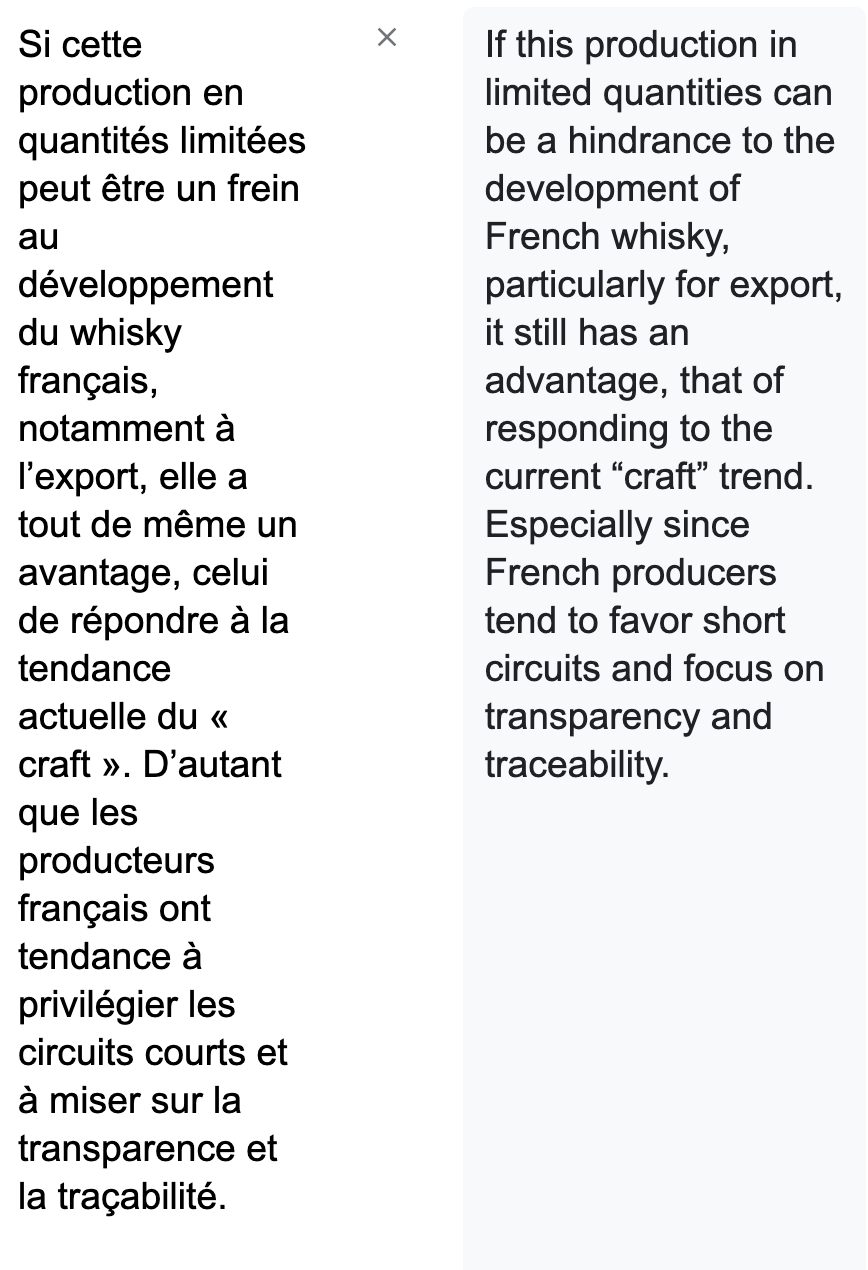
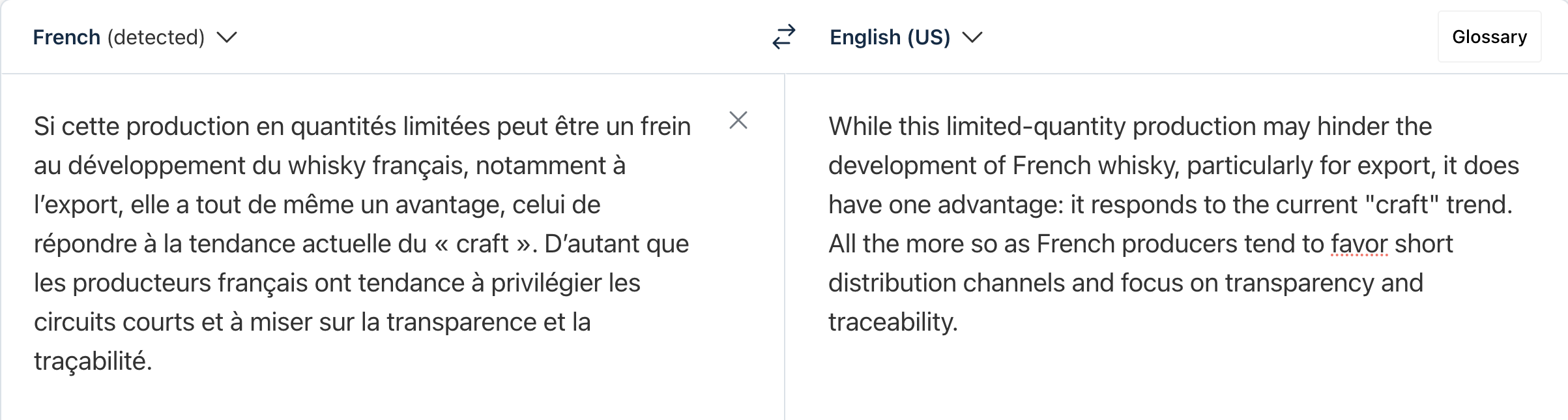
“Si cette production en quantités limitées peut être un frein au développement du whisky français, notamment à l’export, elle a tout de même un avantage, celui de répondre à la tendance actuelle du « craft ». D’autant que les producteurs français ont tendance à privilégier les circuits courts et à miser sur la transparence et la traçabilité.”
Let’s say you want to sight translate this from French into English. It may take you a moment to think of good solutions for “un frein au développement” (maybe the first thing that springs to mind is “a brake”, but that doesn’t sound right), “répondre à la tendance actuelle”, “privilégier les circuits courts”, and “miser sur la transparence”.
The risk if you’re working from French into English is that you will stick too closely to the French (i.e. copy the word “privilege” for instance). The result will be over-literal and sound unnatural.
Let’s take a look at what Google Translate gives us for this paragraph.
“If this production in limited quantities can be a hindrance to the development of French whisky, particularly for export, it still has an advantage, that of responding to the current “craft” trend. Especially since French producers tend to favor short circuits and focus on transparency and traceability.”
Now we need to assess the output.
I rather like “be a hindrance” for “un frein au développement”. You could take things a step further by looking it up on Linguee, for instance, where you would find alternatives such as “an impediment” or “an obstacle”.
“Favor” is a good solution for “privilégier” (we obviously want to avoid saying “they privilege short circuits”), and “focus on” works pretty well for “miser sur” (the literal meaning is “bank on” or “rely on”, but these are not so successful).
On the other hand, I’m not so keen on “short circuits”, which I don’t think is the most commonly used expression in English, and clauses beginning with “si” always ring alarm bells, since they’re not always true conditionals in French. If I were interpreting this into English, I would not begin with “if this production…can be a hindrance”.
Let’s take a look at DeepL:
“While this limited-quantity production may hinder the development of French whisky, particularly for export, it does have one advantage: it responds to the current “craft” trend. All the more so as French producers tend to favor short distribution channels and focus on transparency and traceability.”
This version has fixed the “if” problem, and offers us “short distribution channels”, which I think is clearer in English than “short circuits”. To be honest, I often go for something that emphasises local production or direct sales, since that reflects the idea in French.
Example 3: Wagyu beef, English>French
A seemingly random topic – I’m sure you will have guessed I was preparing for an assignment.
This is the paragraph I put through Google Translate.
“We also have a small but wonderful fold of Highland cattle. Our mission is to produce the best beef in the world from our 25,000-acre estate, set within the majestic highland landscape of Perthshire, Scotland which offers rich, fertile grasslands on which all our herds graze.
Established by husband and wife team Mohsin Altajir and Martine Chapman in 2011, our ethos of quality, respect and precision underpins everything we do. What should have been a hobby turned into a full blown business overnight. Mohsin was playing golf six days a week and Martine was looking for something to sink her teeth into.
They had never set foot on a farm before or been up close and personal with cattle. It was their passion for great quality produce and their love of animals that saw them move to the Highlands of Scotland and so Highland Wagyu was born.”
If you’re not Scottish, you may not know what a “fold” of cattle is. There are also a few idiomatic expressions in this text that might give you pause if you’re working into a B language.
Here is Google Translate’s version:
“Nous avons également un petit mais merveilleux élevage de bovins Highland. Notre mission est de produire le meilleur bœuf au monde à partir de notre domaine de 25 000 acres, situé dans le majestueux paysage des hautes terres du Perthshire, en Écosse, qui offre des prairies riches et fertiles sur lesquelles paissent tous nos troupeaux. Créée par l’équipe mari et femme Mohsin Altajir et Martine Chapman en 2011, notre philosophie de qualité, de respect et de précision sous-tend tout ce que nous faisons. Ce qui aurait dû être un passe-temps s’est transformé du jour au lendemain en une véritable entreprise. Mohsin jouait au golf six jours par semaine et Martine cherchait de quoi se mettre à pleines dents. Ils n’avaient jamais mis les pieds dans une ferme auparavant ni été en contact étroit avec du bétail. C’est leur passion pour les produits de grande qualité et leur amour des animaux qui les ont amenés à s’installer dans les Highlands d’Écosse et c’est ainsi qu’est né Highland Wagyu.
And DeepL’s:
“Nous possédons également un petit mais merveilleux troupeau de bovins des Highlands. Notre mission est de produire le meilleur bœuf du monde à partir de notre domaine de 25 000 acres, situé dans le majestueux paysage des Highlands du Perthshire, en Écosse, qui offre des prairies riches et fertiles sur lesquelles paissent tous nos troupeaux.
Fondée en 2011 par Mohsin Altajir et Martine Chapman, une équipe composée d’un mari et d’une femme, notre éthique de la qualité, du respect et de la précision est à la base de tout ce que nous faisons. Ce qui aurait dû être un hobby s’est transformé en une véritable entreprise du jour au lendemain. Mohsin jouait au golf six jours par semaine et Martine cherchait quelque chose à se mettre sous la dent.
Ils n’avaient jamais mis les pieds dans une ferme auparavant et n’avaient jamais côtoyé de près le bétail. C’est leur passion pour les produits de grande qualité et leur amour des animaux qui les ont amenés à s’installer dans les Highlands, en Écosse, et c’est ainsi qu’est né Highland Wagyu.”
Let’s go through the two translations and see what we can pick up:
“nous possédons” gives us a more formal version of “nous avons” un troupeau
a cattle fold is clearly a “troupeau” (or “élevage”)
“s’est transformé en véritable entreprise du jour au lendemain” works well for “turned into a full blown business overnight”
“jamais mis les pieds” is good
“contact étroit avec le bétail” and “côtoyer” could both work
I have concerns about “quelque chose à se mettre sous la dent”! It sounds as if Martine wants something to eat, as opposed to sinking her teeth into a new project. In other contexts, I might try “s’attaquer à”. What about “un nouveau défi à relever”, or simply “un nouveau projet”?
I’ve deliberately chosen not to share “perfect” versions from DeepL or Google Translate (I doubt that there is such a thing anyway).
Instead, I hope I’ve illustrated for you how I use this tool in practice. It can be a useful shortcut, because it saves time on looking words up in the dictionary or using a collocations dictionary. It can partially compensate for the lack of a practice partner or coach, but it works best if your B language is already strong, so you can filter out the dross and spot little gems.
2. Flash cards with a twist
Now let’s turn to my second technique, which is one you may very well have used when trying to add a new C language: flashcards.
Old-style flashcards (literally small rectangles of card on which you write with a pen) are as antiquated as the abacus, I suppose. Nowadays you can choose from a plethora of apps with flashy features to improve the efficiency of your revision (and make it more fun).
I’ve been familiar with some of these apps, e.g. Anki and Quizlet, for a long time, but haven’t really used them myself, since I haven’t added a C language in living memory.
However, I recently decided to help my daughter with revising biology, chemistry, and physics, and I thought electronic flashcards would be more fun than paper.
I tried Anki first, but I didn’t like the look or features. I wanted something very intuitive, quick to learn, and fun to use. So then I tried Quizlet, and loved how easy it was to add audio to the flashcards, or even images. You can even pick from a gallery of suggested images. When it comes to using the flashcards for revision, you can set them to play a matching game, or use them in a variety of different ways to learn or revise the material. The magic algorithms will ensure you spend more time on the cards you get wrong initially.
From there it was a small step to thinking “aha, I’ve been writing down vocabulary about cattle farming/barley production/distilling whisky, so I’ll create some flashcards with key words”.
Obviously if you’re working on a B language, the point isn’t to recognise and understand vocabulary in a passive language, but to be able to think of the equivalent in your B language as quickly as possible (i.e. to activate your vocabulary).
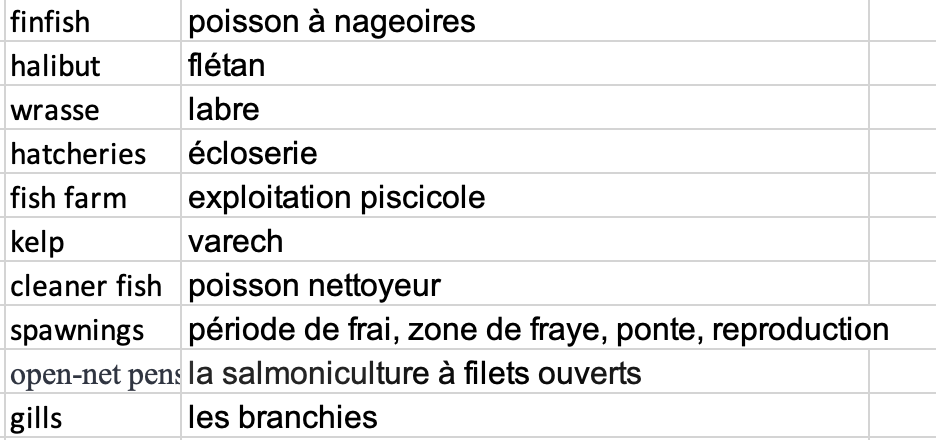
Here’s some vocabulary I was working on, related to salmon farming:
The basic version of Quizlet is free, and took me less than five minutes to set up.
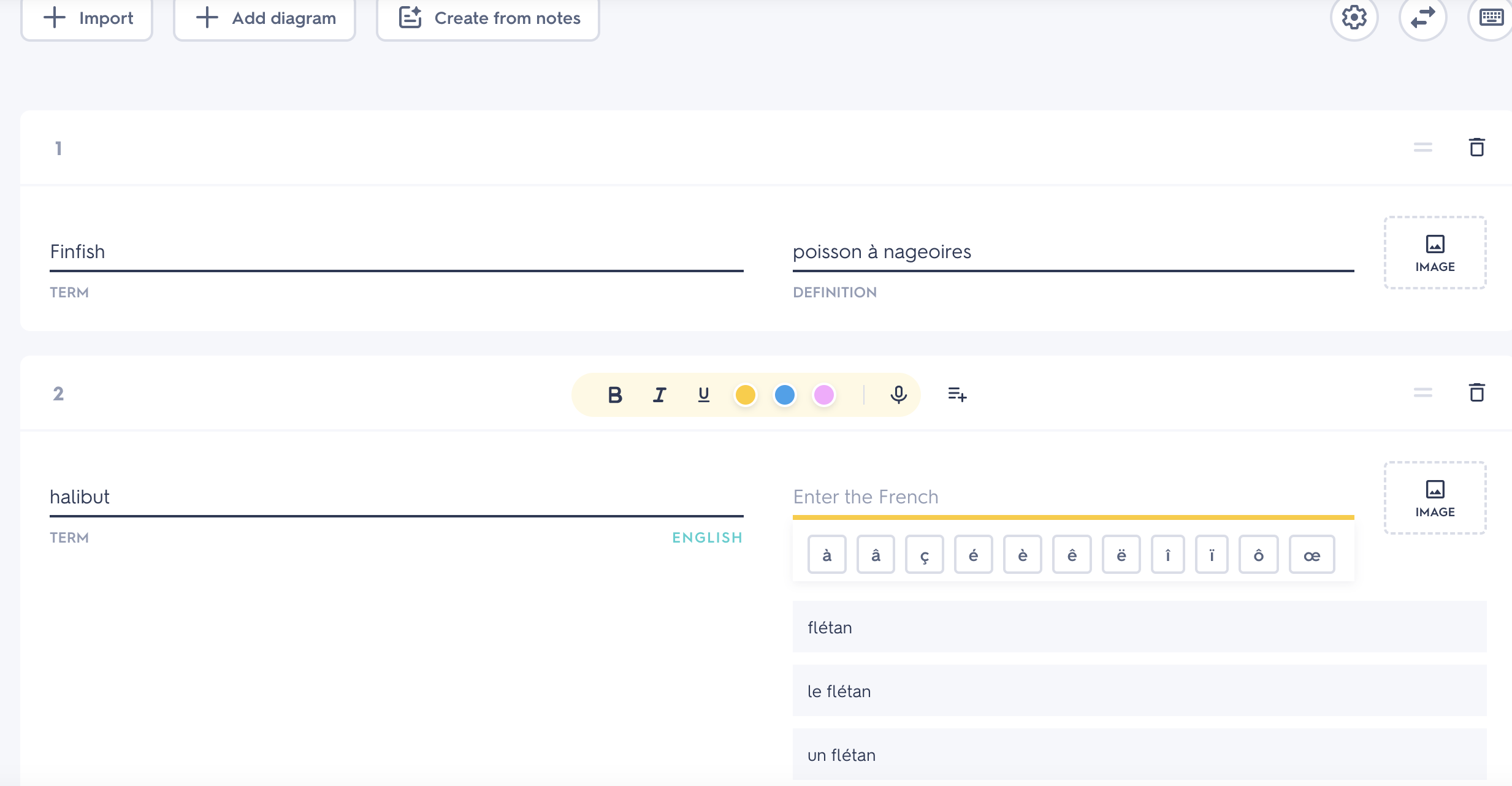
You can go the DIY route and create your flashcards from scratch. Here’s an example. I’ve typed in my first two terms, finfish and halibut. You’ll see that once I typed in ‘halibut’, the system offered me suggestions for the French equivalent.
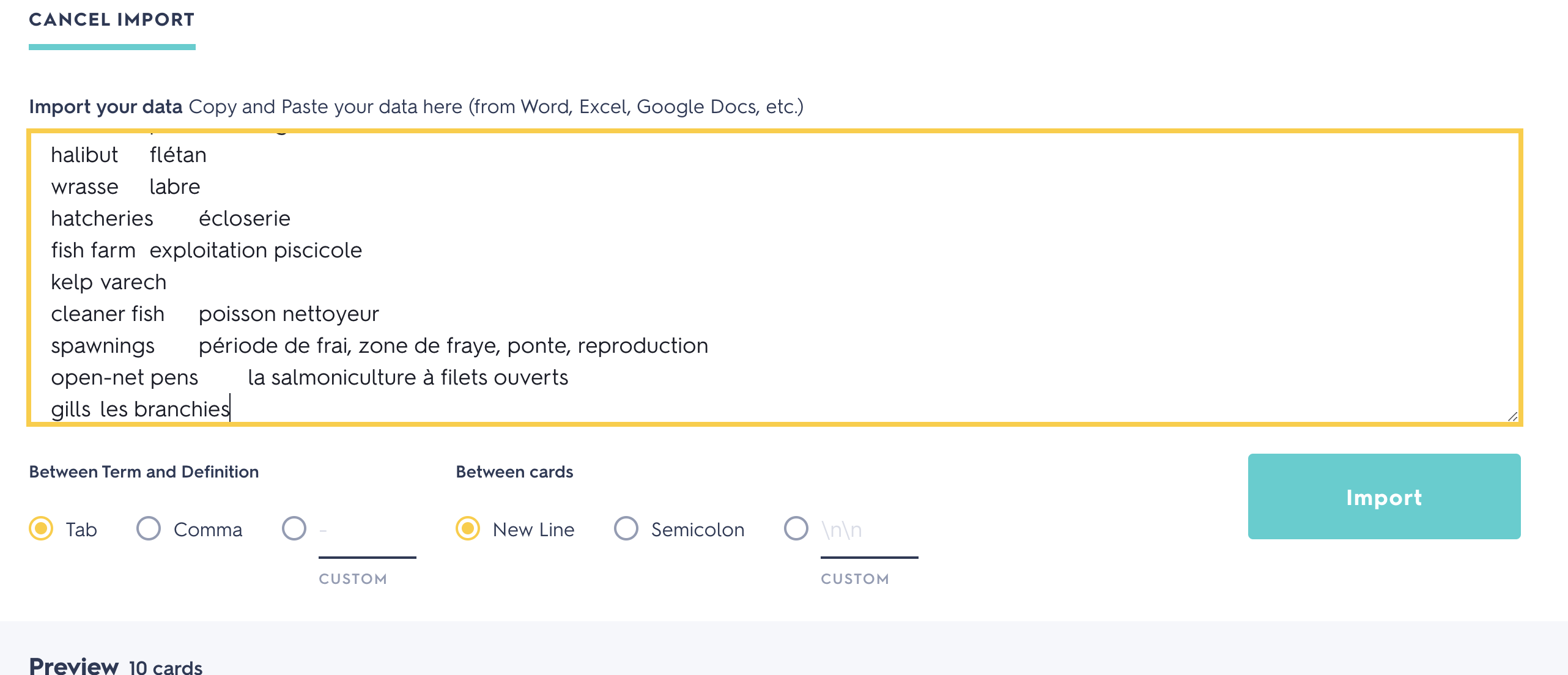
There’s an even faster way to create cards, though: use the ‘import’ function. Just copy/paste the Excel cells into the ‘import’ box:
Bob’s your uncle! The system creates 10 cards for you (or as many as you like) in one fell swoop!
Back in the day, to try to anchor this terminology in my mind and make it part of my active French, I would have reread my vocabulary lists several times (jotted down in a notebook, two decades ago, then typed into an Excel spreadsheet more recently).
My aim with the flashcards is to see the word on the front of the card and be able to come up with the French equivalent immediately, to help develop faster reflexes. Using an app is a targeted way of making improvements, since you can mark the flashcards you know well, so the algorithm only shows you the ones that still need work.
One more feature that might be helpful to retourists: you can add audio to the flashcard, to help you with pronouncing tricky words in your B language.
Now it may well be the case that everybody out there has been using these techniques for age already, and I’m behind the times. 😁 That’s OK…I’m increasingly aware that I am gradually becoming a technological dinosaur.
[By the way, if you’re interested in using AI to help you with your language learning, why not join the new AI Language Club, from the indefatigable Josh Goldsmith and Kerstin Cable? If you follow the link, you’ll find a free webinar to start you off.]
What are your fun techniques for improving your retour?
If you enjoyed this exercise, you’ll find plenty more where that came from in my programme for English retourists, Rock your Retour.
The website contains hundreds of articles and exercises designed specifically for interpreters with an English B, and you can also join weekly live practice sessions, where I give members feedback on their interpreting into English.
Enjoy this blog? Please spread the word :)
By continuing to use the site, you agree to the use of cookies. more information
The cookie settings on this website are set to "allow cookies" to give you the best browsing experience possible. If you continue to use this website without changing your cookie settings or you click "Accept" below then you are consenting to this.