

Your trainers are only as good as you make them

Your trainers are only as good as you make them blog image

I hesitated about the title of this blog post for a long time. Not least because it sounds as if I’m writing about shoes.

At first, I wanted to write about what I have learned from my students over the years. And then I wanted to write about how students can help their trainers step up and do better, because that is what some of my students do for me. Really, I’m writing about the symbiosis between student and trainer that can lead to breakthroughs on one side and excellence in teaching on the other.

But all of this is difficult to encapsulate in a blog title. I reckon if you read on, you’ll see what I’m getting at. So please bear with me. *

What my students have taught me

Every so often, I hear a teacher/trainer/tutor say ‘I learn so much from my students’. And on my jaded days, I think: ‘Nope, I’ve learned diddly squat from my students today. And that’s because they have no life experience, they need a bit more get-up-and-go, and the education system has given them a sense of entitlement and little idea of what independent thought looks like. And now I’m old, they all look about 15.’

And then I give myself a good slap round the head.

facepalm

Sometimes I just forget what it’s like to start out – not in all areas, because I’ve certainly taken up new activities and learned new skills as an adult (I’m a permanent beginner when it comes to driving and parking, for instance, and have only just begun a long journey in web building and marketing) – but it’s a long time since I was a postgrad student. Let’s face it, when I embarked on my interpreter training course at the tender age of 21, I was deeply ignorant about current affairs, had very little work experience, and was probably more sheltered and naive and certainly vastly less streetwise and tech-savvy than students today. This is, in fact, totally normal. It doesn’t mean I had nothing to contribute, and the same goes for my students today.

I don’t learn from all my students every day (and let’s be honest: they probably don’t learn something new from me every single day), but some of my most valuable lessons as a trainer have come from my students.

Grit and determination

Acquiring the skill set required to become a professional interpreter is hard. Attending an interpreting course where you receive feedback on your performance every day in front of all the other students is very hard, psychologically speaking.

I benefited (if you can call it that) from the bootcamp style of interpreter training: short, fairly brutal, and effective (if traumatic).

drill sergeant meme
* note that I’m not giving any hints about which of my esteemed colleagues at the European Commission had drill sergeant tendencies.

I was fortunate enough to pass the final exam, and start work straight away with a good employer. So all the hard stuff was done in six months, with a good outcome at the end. So all the hard stuff only appeared to last six months (but after that there was a massive learning curve which still hasn’t ended…).

It doesn’t happen like that for everyone. In fact, these days, what with the labour market in general and the interpreting market in particular being quite different from 25 years ago, students have to a) make it through their interpreting course successfully, and b) market themselves successfully in order to find any work in a sometimes saturated and ungrateful market. They need bucketloads of versatility, determination, professionalism, and skills I just didn’t need or have when I started out. And they need many more strings to their bow.

Every so often I come across a student who deeply impresses me with his or her ability to navigate the myriad challenges I’ve just mentioned with grace and enthusiasm, and who demonstrates maturity, resilience, and willingness to learn. A couple of years ago I had a student in my French interpreting class, E., who never gave up. She wasn’t in the top spot at the beginning of the year and it wasn’t all plain sailing. She had issues with her delivery and use of English that needed addressing. But she Never. Gave. Up. She listened to feedback, she applied feedback, she worked hard, she worked well with others, she welcomed advice but didn’t need hand-holding, and after graduating, she set herself some goals and went after them with passion and determination. Perhaps it had something to do with her hobby of weightlifting, and that mental attitude carried over into her interpreting, I don’t know. She certainly had exactly the right mindset to make progress. By the time she graduated, her skills had improved significantly, and she hasn’t rested on her laurels. She is now actively involved in organising collaborative practice groups for colleagues, as well as consolidating her interpreting skills, blogging, and working on a retour.

The reason I mention this student is because she was a great reminder to me of how much can be achieved with tenacity and dogged determination, even if you don’t start from the most comfortable position.

Sometimes there seems to be a feeling among trainers that interpreters are born, not made; that you need special talents to become an interpreter, and that if you lack innate talent, you will fail.

I love this reminder from E., and some of my other students, that you can achieve so much in life by just doing the work without excuses or procrastination, and that success doesn’t have to be immediate. It may take a few months or a few years longer, but it is success nonetheless (some of my former students passed accreditation tests at European Institutions or started work as professional interpreters several years after graduating). The lesson here for trainers is never to give up on students who are struggling or taking longer than expected to pick up skills.

It is a joy to watch students’ tenacity and enthusiasm in working towards and achieving their goals, and as someone who suffers from perfectionist tendencies (if I can’t get something right first time, I tend to give up), I really admire their attitude.

New technologies

I quite like new technologies. Here I am, writing a blog, organising webinars and running several websites. Nevertheless, I am not a digital native, and my son (aged 10) can already do far more than I can with the TV remote and iPad.

technologically challenged
Me, sometimes.

One of the great things about being a trainer is that the contact with students helps me keep up (a little) with new technologies.

Students have a completely different experience at university these days. When I was a student, email didn’t exist, and word processing was in its infancy. I handed in handwritten work and couldn’t consult google.

These days, students have virtual learning environments, timetable apps, access to lecture recordings, Facebook groups, and more. At the universities where I teach, they also have equipment that can record their performances in the booth, video conferencing equipment in the room, and a smart whiteboard.

If not for my students, I would be one of these:

dinosaur figurineThe fact that our students’ learning environment has evolved so much leads us, as trainers, to think about how we can tap into all these new possibilities; how we can use new technologies to enhance learning, improve productivity, save time, or connect with colleagues around the world.

My students’ familiarity with the Internet, file sharing, and Facebook, for example, led directly to the creation of Speechpool. The increasing use of blended learning has led me to create my new site, The Interpreting Coach. Initiatives such as ORCIT (online resources for conference interpreter training), the SCIC/EP speech repository, streaming of mock conference by many universities, and new apps for interpreters, are the direct result of a) the availability of new technologies, but above all b) the way students and early adopters use and want these new technologies.

It’s when students ask the questions (how can I find practice material/find a practice partner anywhere in the world/organise my glossaries?) that we trainers can look for answers and consider how we can do things better inside or outside the classroom.

Questions, questions

They say there is no such thing as a stupid question. And indeed, as a trainer, I welcome questions. Nobody likes to deliver a lecture and see glazed eyes and bored looks; at least questions from the floor suggest that the audience has been listening.

interpreter trainers

Sometimes my students or coaching clients ask questions – about interpreting technique or use of language – that are very difficult to answer. I struggle with these, because I don’t want to give a confusing or misleading answer; and because language is full of nuance and subjectivity, and I can’t always offer unambiguous or definitive answers.

These questions, though, are my lifeblood as a trainer. They force me to reflect on technique or use of English. They help me to look at my own language differently. They spur me on to give clearer explanations, or to develop teaching materials to explain the linguistic challenge in question.

Just this morning, a coaching client asked me to explain salami technique (also known as ‘chunking’). It was a great opportunity for me not only to explain the principle, but to find specific examples at the syntactic level to explain the advantages of the technique. When I’m asked to explain something I take for granted in my own interpreting, it’s a great opportunity to take a fresh look at it and see if there is a different or better illustration that will be easier for students to grasp.

Another example: in developing materials for my online membership site, Rock your Retour, for English retourists, I have been heavily inspired by my coaching clients’ questions, and also by their mistakes (why did they use a particular word or phrase? What would have sounded better?). If not for them and my students, my relationship with English, and with interpreting, would stagnate. Instead, my students give me an opportunity to grow, learn, and explain better, and I’m grateful for it.

Students, help your trainers rock!

If you’ve read this far, you’ll have understood, I hope, that when I’m not swamped by my workload and the odd bout of pessimism about the profession, I am both grateful to my students and inspired by them. They make me a better trainer. I don’t believe that training and coaching should take an entirely top-down approach; nor do I believe that 100% student-led learning is necessarily successful. Instead, I like to think of the interpreting student + trainer relationship as being closer to the relationship between a mentor and mentee. A mentor guides mentees to reach their full potential; but a mentor cannot teach every student the same thing, or in the same way. He or she must adapt and respond to the students’ needs and wants.

I didn’t want to end this post, therefore, without giving all the students out there some advice about how you can help your trainers help you. We trainers want to give the best of ourselves, and we want our teaching to be useful. And you can help us do that. How?

  1. Ask questions! Don’t be passive. Instead, take control of your learning. Ask (pertinent) questions (have I said that already?). Spur us on to think critically about language and technique and offer you clearer insights.
  2. Listen to feedback and advice. Try it out when you next interpret.
  3. Adopt a growth mindset. Don’t worry if you’re not perfect at first: you are a beginner. All the stages of your learning are building blocks towards success. This means perfectionism (in the negative sense of ‘all or nothing thinking’) has no place in your learning; instead, be determined and hard-working, and remember that mistakes help you learn.
  4. As a learner, be active, responsible and curious. Try to absorb the advice and insights that your trainers and fellow students can give you, and to use them to become an independent learner. You will spend a brief period of time with your trainers, and the rest of your life maintaining and improving your own skills with far less guidance, so remember that your goal is not to absorb knowledge but to acquire skills and the right mindset for success.

In short, be teachable!

I think it would be grossly unfair, though, to encourage students to be teachable without asking the same of trainers. We’ve all heard of lifelong learning, and anyone who is a professional interpreter knows that you have never finished learning a language or picked up every bit of terminology on a given subject. But I think it’s worth considering how trainers can keep learning and improving too.

With the right approach on both sides, it seems to me that students and trainers can push one another to give more and do better, and create a relationship that is genuinely mutually beneficial.

Trainers, what’s the most valuable lesson you have learned from your students?

*This is, in fact, a phrase I hate. But it is ubiquitous in the UK.


Rock your retour logo colourROCK YOUR RETOUR – A MEMBERSHIP SITE FOR ENGLISH RETOURISTS

Rock your Retour is a unique, new way to improve or maintain your English retour:

With this self-paced programme incorporating live classes, teaching materials and ongoing support, you can boost your skills and confidence and become more marketable.

  • guidance from an experienced interpreting coach who is a native speaker of English
  • opportunities to receive feedback about your production of English and interpreting skills
  • teaching materials tailor-made for interpreters, with an emphasis on English usage (terminology, syntax) and skills
  • ongoing support
  • flexible, affordable, self-paced learning
  • time commitment dependent on your availability and motivation
  • affordable package with no tie-in

Find out more here.



Interpreting Coach logoSophie Llewellyn Smith, writing as The Interpreting Coach, is a coach, interpreter trainer, conference interpreter, designer of online teaching materials, and creator of Speechpool. Follow the blog to pick up tips on how to improve your interpreting skills, and check out the website for digital material to complement your face-to-face learning and empower you to take control of your learning. If you’re interested in personal coaching, why not book a free discovery call?

Post-holiday stress

Post-holiday stress blog post

Back to school, back to stress

Here in Europe, the summer holidays are drawing to a close.

How are you feeling? Do you find the rentrée, as it’s known in French, exciting or overwhelming?

In some ways, I quite like that ‘going back to school’ feeling; as a creature of habit, I enjoy getting back into a routine, and getting stuck into new projects. I also like the excitement of a new academic year at University, with new students full of optimism.

On the other hand, a very full schedule can feel oppressive and overwhelming, and I find myself dragging my feet when trying to get back into professional mode. I like to keep that holiday feeling going a little longer, so as to avoid the sense of stress and anticlimax that accompanies a return to grey skies, cooler temperatures, and humdrum domestic hassles (leaky roofs, cars with batteries gone flat). There are many ways to do this; at the moment my favourites are:

  • eating as if I were still on holiday, with lots of delicious salads.
  • getting up later than usual – I’ll put off my normal 5.45 wake-up call for as long as possible!
  • reading a lot (admittedly, this is sometimes a way of procrastinating, instead of facing up to boring chores).

However, with the best will in the world, I can’t entirely ignore my massive to-do list, which makes September look like an exercise in squaring the circle. I often wish the day had 27 hours or so, so I could have a fighting chance of getting everything done.

Here are my top 3 tips for dispelling that horrible feeling of drowning in all the things you have to do.

Prioritise your to-do list

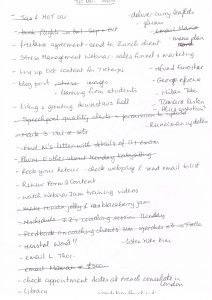
I find lists invaluable for keeping track of all my tasks. But sometimes they outgrow the sheet of paper I’m writing them on, and they look so long.

to-do list

Here’s a simple way to use to-do lists more efficiently.

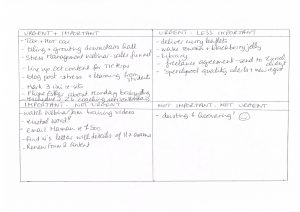
Divide your sheet into 4 boxes: urgent + important, urgent + less important, not urgent but important, not urgent + not very important.

Fill in the boxes with all the things you need to get done.

prioritised to-do list

Now you can see at a glance the ones you actually need to do right away: they are in the urgent + important box. After that, you can move on to urgent but not important, then to not urgent but important, and finally to not urgent + not very important.

Hopefully, if you try this method, you will see that not everything needs doing today. You can plan the order in which to tackle your tasks, and they feel less overwhelming. And perhaps you (or I) will feel less like this.

paperwork hell

Another advantage of this method, as I see it, is that unless I have guests coming to stay, it almost invariably relegates housework to the bottom of the list.

housework meme

On the other hand, the result is that my tidier other half (better half?) is constantly irritated at the mess in the house. I just tell him we have different priorities. 😉

Get outside for a few minutes and practise mindfulness

A good way to escape that crushing sense that you have more tasks to do than will fit into 24 hours is to get outdoors, even for a few minutes. Breathe some fresh air and practise mindfulness, which means nothing more than being in the present and using your senses: listen to what’s around you (can you hear birdsong?), look around and find something beautiful to appreciate. If you can see plants around you, go and rub a leaf or smell a flower: how does it feel? Does it smell good?

stress relief
Lucky me, this is the view from my patio. Instant stress relief!

If, like me, you spend a lot of time studying, reading, researching, using computers, and being indoors, you can end up spending 99% of time in your head, and almost forgetting that you have a body. Ground yourself and use all your senses to remind yourself that you are made up of body, mind and spirit. Exercise is very good for this as well.

smelling the roses

Here is my daughter, aged 7 months at the time, practising mindfulness, i.e. smelling the roses. I was instilling relaxation principles in her at a young age. 😉

Alas, five minutes later, I discovered she wasn’t actually sniffing the rose petals, but chewing on them. This had unfortunate results on her digestive system, which caused some stress. Never mind…

Readjust your mindset

Take five minutes to reset your mindset.

When I was talking to my husband about how he manages his (extremely stressful) job, he suggested reminding yourself that you can only do your best, so there’s no point fretting if you can’t be perfect.

The problem I see with this is that perfectionist types tend to think that ‘doing their best’ means ‘doing everything perfectly’ and aren’t always able to accept what they view as lowering their standards.

Instead, if you want a quick re-boot of your attitude, I would suggest one of the following tricks:

  • Imagine that what you are going through is being described by a friend: the pressure he/she is under, all the stuff he/she needs to do in a ridiculously short time, his/her feelings of inadequacy, etc. What advice would you give your friend?  We are generally far more understanding, sympathetic and helpful to  other people than we are to ourselves. If you can take a step back and pretend someone important to you is faced with this situation, you are likely to give them (i.e. yourself!) more realistic and objective advice.
  • Ask yourself: what’s the worse that could happen? What’s the worst case scenario if you don’t complete your to-do list? Your life won’t apart. Likely, there are only two or three items on there that could have serious consequences on your life or career: do those first, and ignore the rest for now, if you don’t have time for them (or if getting enough sleep/food/exercise/fun is more important to your physical and mental wellbeing).

I hope this has given you some ideas for quick fixes when you’re feeling overwhelmed and you’ve got post-holiday blues.

Perhaps your stress is on a different scale altogether: you’ve got a huge work assignment or interpreting exams coming up, or you’re finding your interpreting course very demanding.

If you’re after more tips and some hard-core stress management advice, I will be holding a 60 minute webinar entitled ‘Stress Management for Interpreters on Thursday, 6th September, followed by a Q&A (cost: €40). I know all about work stress from my own experience as a conference interpreter, but I also have a background in fitness training and complementary therapies, so I like to bring that insight about wellbeing and relaxation into the webinar (I’ll spare you a photo of me in a Lycra leotard, though).

You can register here:
https://events.genndi.com/reg…/818182175026322002/0ac73e8e6f
or on the home page of www.theinterpretingcoach.com (just scroll down to find the webinar details).

Hope to see you there!

In the meantime, why not leave a comment below. Did my tips help? What do you do to reduce that feeling of overwhelm?


Interpreting Coach logoSophie Llewellyn Smith, writing as The Interpreting Coach, is a coach, interpreter trainer, conference interpreter, designer of online teaching materials, and creator of Speechpool. Follow the blog to pick up tips on how to improve your interpreting skills, and check out the website for digital material to complement your face-to-face learning and empower you to take control of your learning. If you’re interested in personal coaching, why not book a free discovery call?
The best way to develop your retour (and it’s not what you think)

develop your retour

‘What do you do to develop your retour?’

I sometimes ask my interpreting students this question. I’m curious to know what they do with their limited time outside of class. The calls on their time are so great (writing essays, researching the topic of the week, preparing speeches, practising interpreting into their A language, attending theory modules and other lectures, and having a life!) that I’m quite sure they want all their self-training to be productive.

In their shoes, I would want to wring every bit of juice from the exercises or activities I did to try to improve my retour. I certainly wouldn’t want to waste time on activities with a limited value.

Yet all too often, this is what they say in response to my question:

  • I listen to the radio in the background.
  • I watch the news on TV.
  • I read the Economist/the papers.
  • I’m flat-sharing with a native speaker, so I get some practice in.
  • I practise interpreting from A into B (but I don’t have anyone to listen to me).

Can you see what the problem is with these suggestions?

Practising interpreting from A into B is the end goal of a retourist. 

If your B language isn’t strong enough, you will produce unidiomatic English (or substitute whatever your B language is). If you don’t have a native speaker or someone with a strong English B to listen to you and make suggestions, you are unlikely to improve your performance next time (although there are ways to get around this – see my blog post for ideas).

In short, although there is definitely a place for practising your interpreting from A into B, it shouldn’t be the be-all and end-all. If you do nothing else, you will get very tired and you may limit your progress. Before you can interpret effectively into your B language, you must have sufficient mastery and flexibility in that language to produce it spontaneously and idiomatically when speaking on a variety of subjects.

Let’s turn to the other typical ‘homework’ activities mentioned by aspiring retourists: listening to the radio, reading widely, watching the news. All these activities are very passive (just think of the implications of ‘in the background’!). They may well improve your knowledge of current affairs and your comprehension of your B language, but you need to go a step further than that. To improve your retour, you need to activate your B language.

Develop your retour by activating your B language

Let’s take another look at those activities and see if we can tweak them so as to make them more active.

Listening to the radio/podcasts or watching TV

  • Try repeating key vocabulary out loud.
  • Take note of useful phrases (whole phrases, not just words, so you get the collocations right).
  • Prepare a short glossary based on the vocabulary used in the programme or podcast you have just heard.
  • After the programme, give a short summary out loud in your B language.
  • Jot down a few arguments (e.g. pros and cons) and prepare a short speech in your B language based on what you’ve heard.

Reading the Economist/the papers/classical literature

The good news about reading in this way is that it can improve your background knowledge and your understanding of cultural aspects of your B language. If you choose your reading matter carefully to address your weaknesses (for instance, if you know you tend to be too colloquial in your B language), you can also work on register while acquiring useful vocabulary. It’s always good to kill several birds with one stone!

  • Take note of useful phrases (whole phrases, not just words, so you get the collocations right).
  • Think carefully about register. What elements of the language make it more formal? Can you incorporate any of these phrases into your interpreting?

Chatting to housemates or friends

Speaking is certainly more active than reading or listening to the radio, and is a good opportunity to expand your vocabulary and speak your B language with greater fluency. It won’t, however, improve your retour significantly if a) the person you’re speaking to doesn’t correct you when you make mistakes, b) you are not aware of nuances of register when speaking to your friends, and you pick up bad habits or phrases that are inappropriate in the workplace, and c) you only ever talk about the same things.

Make sure you are alert to colloquialisms or vulgarity in everyday conversation, to avoid, for example, telling your tutor that you are ‘pissed off’ (as a student once said to me, not realising how rude it was, as her flatmates said it all the time). Be disciplined in everyday conversations; habits such as saying ‘I mean’, ‘you know’, or ‘like’ all the time are very hard to get rid of.

Consider opportunities to speak your B language in a different context, more relevant to your future career. You could join a debating society, for instance.

‘Pre-interpreting’ exercises to help develop your retour skills

I’m calling these pre-interpreting because they are not interpreting exercises per se, but activities you can do instead of, or before, practising interpreting a speech on a given topic. As I said earlier, production takes precedence over interpretation, and these are exercises that will force you to work on reformulation and expressing yourself naturally in your B

  • Preparing a speech on a subject of your choice. This is a great pre-interpreting exercise. Pick a topic, read a couple of articles, take note of a few phrases, and articulate your thoughts in a structured speech in your B language. Afterwards, you might like to try interpreting a speech from A into B on the same subject. You’ll be primed and ready to go!
  • Shadowing. To clarify: I don’t think shadowing in the literal sense of repeating everything you hear is necessarily useful, especially in an A language. However, if your B language is quite weak, shadowing a good speaker is an opportunity to get a feel for intonation patterns and to hear yourself say certain phrases out loud. If your B is stronger, you can use shadowing as a reformulation exercise (listen to the ideas, edit them, and reformulate them); this is a very advanced exercise, but excellent for working on versatility, concision and paraphrasing. Look out for a future blog post about shadowing.
  • Sight translation. Again, this is a challenging exercise, but a great opportunity to think about reformulation. Howe many ways can you think of to express the same idea? Sight translation is also good done in a group, because other members may come up with good ideas.

Develop your retour skills while having fun

It doesn’t all have to be hard work. There are plenty of opportunities for having fun with language and improving your retour skills almost without noticing

  • Don’t forget that basic grammar and vocabulary often need work. There are plenty of useful websites and apps for this. How about Memrise for learning vocab? And why not look for quizzes to help consolidate your understanding of aspects of grammar such as prepositions?
  • Play games. Articulate and Taboo are a lot of fun, and a great way to practise reformulation. A few glasses of wine will help things along! Or why not play your favourite video game, but in your B language?
  • Sneak your B language into your life in other ways. Change the settings on your browser or Facebook so they’re in your B language. If the Economist seems too heavy, read a cookery/cycling/photography magazine in your B language. Find a boyfriend or girlfriend who speaks your B language (as well as the language of lurve).

Conclusion

It’s worth repeating: you can’t interpret well into your B language until you can speak your B language confidently and idiomatically in a variety of situations.

The way I see it, to develop a strong retour, you need to focus first on improving your active language skills in your B, then move on to interpreting. I’m not suggesting you shouldn’t attempt interpreting for ten years, until your mastery of your B language is perfect (as if such a thing were possible!), but my feeling is that when you start trying to develop your retour, you need to focus more on expanding your repertoire (vocabulary, register), consolidating the language and producing it spontaneously or semi-spontaneously. When you do practise interpreting, make sure you have done plenty of preparatory work to smooth the way for a productive practice session and to boost your confidence, which is absolutely critical to working succesfully into a B language.

As your B language improves and you can use your B with greater flexibility and versatility, the balance can shift and you can spend more time on interpreting.

I hope this post has given you plenty of ideas for developing your retour in ways that are productive and sometimes even fun! What works best for you? Leave me a comment – and if you have friends or colleagues who might be interested, please share this post on Facebook or Twitter!

To your success,

Sophie signature transparent


Interpreting Coach logoSophie Llewellyn Smith, writing as The Interpreting Coach, is a coach, interpreter trainer, conference interpreter, designer of online teaching materials, and creator of Speechpool. Follow the blog to pick up tips on how to improve your interpreting skills, and check out the website for digital material to complement your face-to-face learning and empower you to take control of your learning. If you’re interested in personal coaching, why not book a free discovery call?

Football: love it, hate it, use it

Football idioms blog post

Unless you’ve been living in a parallel universe for the past few weeks, you will know what the big event is this Sunday: the World Cup Final between France and Croatia. Even I know it’s happening.

My Facebook feed has a sprinkling of updates from friends – enough for me to have a vague idea of what’s been going on. I was quite smug at the semi-final stage, knowing that I could happily support three of the four teams (being half English and half French, and having lived in Belgium). In our household, though, switching on the TV is a rare treat, and we’re not going to make an exception for the Beautiful Game.

That being said, everything is grist to the mill for a keen interpreter. When it comes to football, whether you love it or hate it, you can make use of it to improve your interpreting, with a plethora of football idioms. I’ll show you how in a minute, but first, I thought I should reach out to others like myself, who are less than keen on football*, with some sneaky tricks to help you be a football faker.

*otherwise known as pedaspheraphobes

If you’re clueless about footie but want to fit in

Here are some safe options for you to pull out of the hat when you’re watching a match with friends.

  • Before the match: ‘I think we’re in for a great game’.
  • In the first half, before things go horribly pear-shaped: ‘It’s early days’, or ‘There’s still everything to play for!’
  • Generic comments that will get you through most situations: ‘Go on!’, ‘Ooooohhh!’, ‘Referee!’, ‘Unlucky!’, and ‘Surely, that was a penalty!’
  • When one of your players is threatened with a tackle: ‘Man on!’
  • After a tackle: ‘Great tackle!’, or ‘Keep your knees to yourself, you idiot!’, depending which side was responsible for the tackle.
  • After a goal: ‘Back of the net!’ or ‘What a goal!’
  • After a save by your side: ‘What a save!’. I’m sure you’re beginning to discern a trend here. Sophisticated exclamations are unnecessary, when ‘What a…[insert appropriate manoeuvre]’ is so versatile, e.g. ‘what a header!’
  • If your side is England: ‘This can’t be happening!’
  • After the match: ‘We were robbed!’

If you’re clueless but aspire to being an armchair pundit*

*pundit: an expert in a particular subject or field who is frequently called upon to give their opinions to the public. (Oxford Dictionary)

This is more dangerous ground, as you will need some football terminology and the ability to make what, on the surface, appear to be insightful observations.

Here are some of the basic terms you will need: kick-off, the pitch, the goalie (or keeper), formations (i.e. how you place your defenders, midfield and forwards), a striker (an attacking player), a free kick (when a player has been fouled), a throw in, offside (there’s no point even trying to explain this term, as the rules are incomprehensible), the group stage, the knockout stage, extra time, a penalty shoot-out, a goalless draw (also known these days as a boredraw) and a hat trick (scoring three goals in one match), although you’re unlikely to need this one if you’re watching England play.

To sound like a football guru, try some descriptive adjectives for the players, for example: ‘he’s very pacey/versatile/fiery’ and be free with the sweeping generalisations ‘France have got a lot of pace’ (i.e. they run fast!), ‘Italy are good at the back’ (i.e. in defence), ‘Croatia had a lot of possession in the first half, but they weren’t able to create opportunities’, and ‘Mourinho has no other option but to park the bus’ (i.e. focusing on defence and blocking the goal, because you fear losing).  Don’t forget to wheel out a few trite clichés, such as ‘some tired legs out there’, ‘that was schoolboy defending’, ‘this is an emotional rollercoaster’, or ‘it’s a game of two halves’ (the fortunes of each team can swing dramatically between the two halves).

If you’re actually after some useful football idioms to improve your work into English

No problem! There are stacks to choose from, and you may be surprised to find you are familiar with some of them already. No need to stick to a sports context, as these idioms are very versatile.

  • to kick off, to get the ball rolling: ‘Ladies and gentlemen, after that brief introduction from the chairman, the floor is open for your comments. Who would like to get the ball rolling?’. ‘I’d like to kick off the meeting with a brief Powerpoint presentation.’
  • to be on the ball: ‘Luckily, the Secretariat was on the ball, and noticed a typo in paragraph 2.’
  • to take your eye off the ball: ‘If we want these negotiations to succeed, we can’t take our eye off the ball for a second.’
  • to know the score: ‘You don’t need to explain the whole process to Mr. Adams. He knows the score.’
  • a game plan: ‘The meeting with our competitors went badly because we hadn’t worked out a game plan.’
  • a game changer: ‘The Ebola vaccine could be a game changer in the outbreak in the Congo.’
  • to watch from the sidelines: ‘So far, I’ve been watching from the sidelines, but I think it’s time I expressed my opinion in this debate.’
  • to score an own goal: ‘The European Union scored an own goal with this legislation, which is too restrictive and hampers exports.’
  • to move the goalposts: ‘I’m frustrated with this project; my boss keeps moving the goalposts, so I never feel as if I’m doing a good job.’
  • to blow the whistle on someone: ‘He was afraid to blow the whistle on his colleagues.’

So there you have it! A handy little toolkit of useful idioms that can be used in many interpreting contexts (sport, business, diplomacy), AND some useful phrases in case you want to feign interest in the World Cup.

I will leave you with a final little bit of British culture. Some years ago, an ‘iconic’ (I hope you can see my air quote marks here) song called Three Lions was released by rock band Lightning Seeds, and football-obsessed comedians Frank Skinner and David Baddiel. It’s called Three Lions and features the chorus ‘football’s coming home’. At the time, this referred to the fact that England was hosting its first major football tournament for thirty years. However, since then the phrase has evolved to refer to football’s most famous trophy, The World Cup, returning to England, where football was invented.

I will employ a little British understatement and say the song has been enjoying a LOT of airplay in recent weeks. But no more (for obvious reasons)! This is no loss to the musical scene. But just in case you feel you should understand this aspect of British culture, here it is:

And now… best go and practise shouting ‘Allez les bleus!’

To your success,

Sophie signature transparent


Interpreting Coach logoSophie Llewellyn Smith, writing as The Interpreting Coach, is a coach, interpreter trainer, conference interpreter, designer of online teaching materials, and creator of Speechpool. Follow the blog to pick up tips on how to improve your interpreting skills, and check out the website for digital material to complement your face-to-face learning and empower you to take control of your learning. If you’re interested in personal coaching, why not book a free discovery call?

How to make English work for you when you’re working into English

Make English work for you image

English


In any situation in life where you want to excel, it makes sense to work to your strengths and find ways to compensate for your weaknesses. Interpreting is no exception. Adapting to the situation you find yourself in, and using your advantages strategically means making the most of your own strengths and talents (the way you express yourself in your mother tongue, or the fact you’re not afraid of numbers).

However, your personal skills as an interpreter are only one side of the coin. The other side is the tools at your disposal. The right tools can help you do a good job. Maybe you use glossary tools or a tablet in the booth to improve your performance, or you own a particular headset which offers excellent sound quality.

I have in mind something else, though. Rather than tools such as the equipment, the headset, your notepad or glossary, I’m thinking of the language itself, and how you use it. After all, language is your primary tool when you’re working as an interpreter: language is what you wield, mould and shape to your purpose, in order to convey the speaker’s message. Much of the joy of interpreting, in fact, lies in manipulating language.

Not all languages are born equal, though. In the same way that you’re better off making grilled vegetable kebabs than soufflé if you’re cooking on a barbecue, if you’re working into English, you need a particular mindset. Don’t try to work into English in the same way as you would work into Italian, Japanese or Russian. Make English work for you, not against you.

Today I want to focus on how you can turn the very features of your target language, English, to your advantage.

When interpreters have an English B and are working from their mother tongue into English, they may enjoy it for reasons no more complicated than a) they understand everything that is being said by the speaker, and b) their English is pretty strong, and they feel comfortable using it.

I think it’s worth giving a little more thought to why English can be such a great language to work into, whether it is your B language or your A. With a deliberate awareness of the useful features of English, from an interpreting perspective, you can think strategically and improve your interpreting performance.

The joys of working into English

If you’re multilingual, you may feel, as I do, that languages have personalities. Just as an individual can be romantic, surly, crisply practical, informal or abrupt, so can a language (if you’re willing to entertain a few clichés, and a healthy dose of subjectivity).

Greek is quite good at sounding hectoring, but also redolent with layers of history. French can sound impressively abstracto-intellectual. German can be blunt and punctilious. And every language has to be manipulated differently for the speaker (and the interpreter) to sound intelligent, which is generally what he or she is aiming for.

So what is English good at (or good for)?

Well, as it’s a global language, listeners tend to be rather forgiving. After all, most people these days are accustomed to hearing several varieties of English, including American English, and probably Globish as well. I won’t get sidetracked into a rant about the evils of Globish, since this is supposed to be a relentlessly positive post. Instead, I want you to think about how fortunate you are to be working into English, instead of a language that, say, has an Académie, and frowns on any loan words whatsoever. So you can generally be confident that your audience will have a more flexible view of what constitutes ‘correct’ usage than if you were working into French, say. On the whole, people listening to the English booth are not overly pedantic, unlike some members of the booth itself (believe me, I’m one of them); and let’s not forget, many listeners are not native speakers of English themselves, so they are hardly likely to quibble over a split infinitive. That leaves you free to relish the fact that you can use all the buzzwords and neologisms making the headlines, that are so often difficult to translate (‘upskirting’ was a topic of debate in the British media last week, for example), and enjoy not having to do mental gymnastics to translate acronyms.

A further advantage of English is that there is such a wealth of material, both in print and online, that you can easily research any topic under the sun, and pick up all sorts of useful phrases to inform your interpreting. This is very helpful when preparing for assignments and working on your English retour.

Make English work for you

Research and preparation are not interpreting skills per se, and your audience’s benevolent disregard of any infelicities of language may be an advantage, but is also beyond your control.

There are, however, many intrinsic features of English that you can control in order to improve your interpreting performance. Here are a few of them:

    • informality. No need to worry about tu, vous, Sie, usted or εσείς. The days of thee and thou are long gone, and English tolerates a generous degree of informality. Don’t bother with ‘one’, unless you want to sound stilted and old-fashioned, or you are the Queen; go for ‘you’ instead. Obviously, some circumstances will require you to be excessively ritualistic and to use honorific titles, such as when you are addressing ‘my right honourable friend’ in Parliament. So do bone up on forms of address, just in case; but you’ll generally only need them at the beginning of a formal speech.  The rest of the time, you don’t need to fret too much about the speakers’ relative seniority or hierarchy, and you certainly don’t need to learn polite forms of certain nouns, verbs or phrases, as you would in Japanese, for instance.


    • flexibility in the register that is considered acceptable. In some languages, such as French, there is a huge gulf between the spoken language (especially when used by young people) and the sort of language that is considered acceptable at a conference, for example. If you learn French by living in the country and chatting to people, you’ll know plenty of slang, but you will never pick up the sort of formal vocabulary you need when you’re interpreting. In English, the gap between everyday language and conference-speak is much smaller. Abrupt shifts in register will certainly have conference delegates pricking up their ears, and there is a baseline of informality beneath which it is inadvisable to venture, unless you want to risk sounding less than authoritative (or unless it’s appropriate, in a public service setting such as a police interview, for instance). Nevertheless, you can get away with relatively colloquial expressions in English in a way that you can’t in some other languages. English speakers rarely wield language in that ‘poker up the backside’ way that speakers of, say, French do – with apologies for picking on the language of Molière again (but as it’s one of my mother tongues, I don’t feel too guilty).


    • short words. This may sound trivial, but when you’re under pressure in the booth, it’s not. English is generously endowed with short words, often of Anglo-Saxon origin. Much of the time, there is also a word equivalent in meaning, of Latin, Greek or French origin. A few randomly chosen examples: enough (or sufficient), clap (or applaud), ban (or prohibit), and hence (or consequently). When you’re dealing with fast, dense source material in simultaneous, or trying to keep it snappy in consecutive, go for the short version, rather than the long one. One caveat (or warning, to use an old English word): using longer words of Latin or Greek origin usually boosts the register of your speech, making it sound more formal. If you’re going for short and snappy, give some thought to register. You may have to compensate by adding a touch of formality elsewhere.


    • short sentences. You can construct short sentences in any language, I imagine. The problem is that in some languages, it can make you sound stupid or childish. Luckily, this is not the case in English. There is no reason why you cannot make a sophisticated argument using simple syntax, i.e. sentences with a SVO (subject verb object) structure. After all, you can use sophisticated vocabulary and link the sentences in such a way as to present a subtle argument. All of this means that you can chunk (or salami, depending how food-oriented you are) to your heart’s content. Chop up long and complicated sentences in the original, reinvent them as SVO, make them more digestible, and get them out of the way. If you’re in the booth, this will lighten the load on your working memory, and allow you to concentrate on what comes next, unencumbered by having to remember the subject of a very lengthy sentence with two relative clauses. An added bonus is that you will be spoon-feeding the content to your (grateful) audience, and making life a lot easier for anyone taking you on relay.


    • versatility. English is essentially a mixture of Saxon and Norman French, with a liberal sprinkling of Latin and Greek vocabulary, and loan words from other languages.  That doesn’t mean that it has more words than other languages; just think of how German can coin words like Weltmarktführer (world market leader) and Turkish can apparently say ‘Were you one of those people whom we could not make into a Czechoslovak?’ in one word. There’s no denying, though, that English is a rich language, with enough flexibility in its register, word order and grammar to make it very versatile. More versatility = more choices for you when you’re interpreting.


    • Intonation. Just as a picture is worth a thousand words, appropriate intonation is worth…well, not a thousand words, but it can certainly save you a few in the booth. You can use intonation instead of, or as well as, words to show that you are beginning a sentence, finishing an idea, mentioning an aside, or enumerating examples; to show that you’re bored, excited, amused, sceptical, or irritated with the chairman’s proposal; to emphasise an idea or dismiss it; to let your audience know you can accept a proposal wholeheartedly or reluctantly; to express gratitude or to poke fun. When you’re a bit short of linguistic resources because you’re working into your B, intonation can help you gloss over a lack of terminology. Above all, intonation can help you mark transitions in a speech, and highlight what is most important. In short, intonation is your friend. It’s a shame it’s underused by interpreting students, particularly those with an English retour. While difficult to master, especially if your mother tongue has very different intonation patterns (e.g. Mandarin), authentic intonation is a shortcut. Instead of saying ‘and now I’m going to move on to the next point of my presentation, which is an analysis of the balance sheet’, you could simply say ‘now’, or ‘moving on’, or ‘now, turning to the balance sheet’, with the right intonation, and save yourself a lot of time – time better spent concentrating on the next thing the speaker is saying, which is far more important. Sometimes, intonation is less of a shortcut, and more of a lifesaver. Many years ago, I was in a meeting where the Greek delegate uttered a string of incomprehensible words. My interpretation went something like this: ‘Chairman, we can accept the proposal. But…well…we can go along with the proposal. But…we can accept.’ Gibberish, except for my intonation, which clearly conveyed the message that the Greek delegation was willing to go along with the proposal, but only with great reluctance. Sadly, that was the best I could do with the combination of an unknown idiom and the Ancient Greek phrase Ὦ ξεῖν᾿, ἀγγέλλειν Λακεδαιμονίοις ὅτι τῇδε // κείμεθα τοῖς κείνων ῥήμασι πειθόμενοι. I have been waiting twenty years for the same quote to come up in a meeting, so I can glibly say ‘go tell the Spartans that here, obedient to their laws, we lie’. And watch the people taking me on relay tear their hair out.

I see I’m beginning to drift off course, so let me get back to the point. English is irritating in many ways. For example, what idiot invented the spelling system? *


English spelling


But it’s also packed with features that are useful to interpreters. Make the most of them! Play to the strengths of the language. And by that I mean, when you’re practising interpreting into English, give some conscious thought to how you can use voice, exploit the versatility of the language, and above all, be concise. This approach will release some of your ‘processing capacity’, freeing up mental space so you can concentrate on the message you’re trying to interpret. If necessary, write a little reminder on a Post-It note and have it in front of you in the booth (‘Be concise!’, or ‘Intonation’).

To my mind, there is no better evidence of the importance of these aspects of English than the fact that the hallmark of a good speech is often humour. Even a politician’s speech on a formal occasion such as a Party Conference will be rated highly if it combines gravitas and authority with wit and self-deprecation. And what does humour rely on, if not a degree of informality, idiomatic English, and intonation to build rapport with the audience and highlight the punchline?

Look out for my next blog post, when I will have more to say about conciseness (or concision, if you want to up the register).

In the meantime, I’d love to hear from you. What features of English help you interpret better? Leave a comment below the blog post!

To your success,

Sophie signature transparent


* A poem about spelling

I take it you already know
Of tough and bough and cough and dough?
Others may stumble, but not you,
On hiccough, thorough, lough and through?
Well done! And now you wish, perhaps,
To learn of less familiar traps?
Beware of heard, a dreadful word
That looks like beard and sounds like bird,
And dead: it’s said like bed, not bead –
For goodness sake don’t call it deed!
Watch out for meat and great and threat
(They rhyme with suite and straight and debt).
A moth is not a moth in mother,
Nor both in bother, broth in brother,
And here is not a match for there
Nor dear and fear for bear and pear,
And then there’s dose and rose and lose –
Just look them up – and goose and choose,
And cork and work and card and ward,
And font and front and word and sword,
And do and go and thwart and cart –
Come, come, I’ve hardly made a start!
A dreadful language? Man alive!
I’d mastered it when I was five!

Attributed to T S Watt, 1954


Interpreting Coach logoSophie Llewellyn Smith, writing as The Interpreting Coach, is a coach, interpreter trainer, conference interpreter, designer of online teaching materials, and creator of Speechpool. Follow the blog to pick up tips on how to improve your interpreting skills, and check out the website for digital material to complement your face-to-face learning and empower you to take control of your learning. If you’re interested in personal coaching, why not book a free discovery call?

error

Enjoy this blog? Please spread the word :)

By continuing to use the site, you agree to the use of cookies. more information

The cookie settings on this website are set to "allow cookies" to give you the best browsing experience possible. If you continue to use this website without changing your cookie settings or you click "Accept" below then you are consenting to this.

Close